
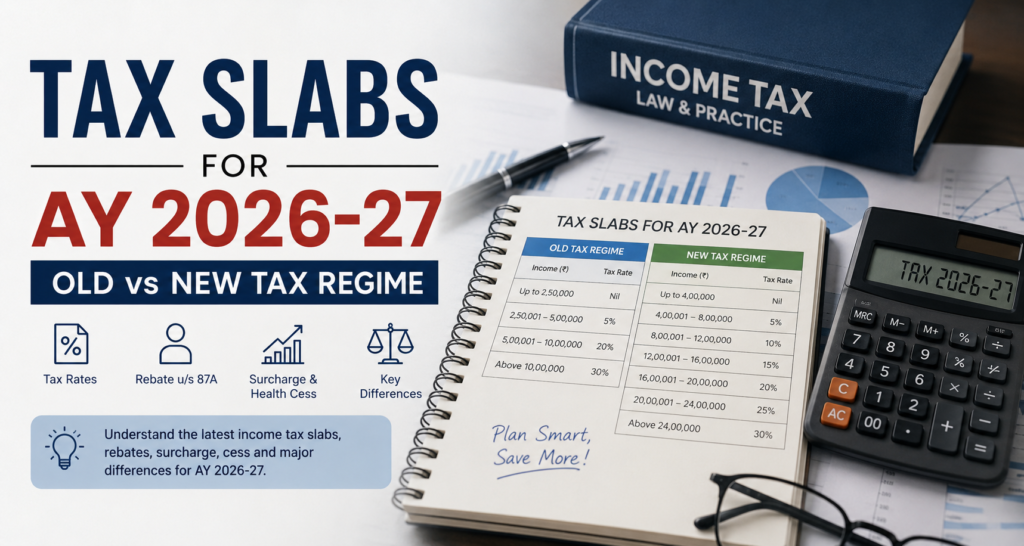
Tax Rates for Assessment Year 2026–27
1. Old and New Tax Regimes The new tax regime under Section 115BAC is the default regime for eligible individuals, HUFs, AOPs (other than co-operative societies), BOIs and Artificial Juridical Persons. However, eligible taxpayers may opt for the old tax regime. For taxpayers without business or professional income, the choice of regime can generally be made annually while filing the return. Taxpayers having business or professional income who wish to opt out of the new regime are required to furnish Form 10-IEA within the prescribed time. Refer : https://www.incometaxindia.gov.in/income-tax-rule-2026 2. Tax Slabs for Individuals Below 60 Years and HUF Total Income Old Regime New Regime Up to ₹2,50,000 Nil — ₹2,50,001–₹4,00,000 5%* Nil ₹4,00,001–₹5,00,000 5% 5% ₹5,00,001–₹8,00,000 20% 5% ₹8,00,001–₹10,00,000 20% 10% ₹10,00,001–₹12,00,000 30% 10% ₹12,00,001–₹16,00,000 30% 15% ₹16,00,001–₹20,00,000 30% 20% ₹20,00,001–₹24,00,000 30% 25% Above ₹24,00,000 30% 30% *The slab-wise computation under the old regime should be applied as prescribed in the source material. The new-regime slabs are ₹4 lakh, ₹8 lakh, ₹12 lakh, ₹16 lakh, ₹20 lakh and ₹24 lakh. 3. Surcharge and Health & Education Cess Total Income Old Regime New Regime Up to ₹50 lakh Nil Nil ₹50 lakh–₹1 crore 10% 10% ₹1 crore–₹2 crore 15% 15% ₹2 crore–₹5 crore 25% 25% Above ₹5 crore 37% 25% Health & Education Cess: 4% of the tax liability is applicable to all assessees. 4. Senior and Super-Senior Citizens Under the old tax regime: Senior Citizens (60 years or more but below 80 years): Super-Senior Citizens (80 years or more): The new regime provides the same applicable slab structure irrespective of age. 5. Rebate under Section 87A Resident individuals may claim rebate under Section 87A, subject to the prescribed conditions: The rebate is not available against income taxable at special rates, such as certain capital gains and casual income. 6. Major Differences Between the Two Regimes Particulars New Regime Old Regime Default regime Yes No Standard deduction from salary ₹75,000 ₹50,000 Entertainment allowance deduction Not allowed Allowed Professional tax deduction Not allowed Allowed HRA exemption Not allowed Allowed Interest on self-occupied house property loan Not allowed Allowed Inter-head set-off of house property loss Not allowed Allowed Chapter VI-A deductions such as 80C, 80D, 80G Generally not allowed Allowed Certain specified deductions such as 80CCD(2), 80CCH(2), 80JJAA and 80LA(1A) Allowed Allowed Basic exemption limit ₹4,00,000 ₹2,50,000 Section 87A rebate Up to ₹60,000* Up to ₹12,500* *Subject to the prescribed income limits and conditions. Quick Revision New Regime: Higher basic exemption + lower slab rates + fewer deductions + default regime. Old Regime: Lower basic exemption + higher slab rates + wider availability of deductions and exemptions. This version is substantially more student-friendly and exam-oriented than the original, while preserving the structure and terminology of your source. The Income-tax provisions for Assessment Year (AY) 2026–27 provide taxpayers with two alternative systems of taxation—the Old Tax Regime and the New Tax Regime under Section 115BAC. The new tax regime is the default tax regime for eligible taxpayers, including Individuals, Hindu Undivided Families (HUFs), Associations of Persons (AOPs), other than co-operative societies, Bodies of Individuals (BOIs), and Artificial Juridical Persons. However, eligible taxpayers have the option to opt out of the new tax regime and choose taxation under the old tax regime. The principal difference between the two regimes is that the new tax regime provides a higher basic exemption limit and concessional slab rates, but restricts several deductions and exemptions. On the other hand, the old tax regime provides a wider range of deductions and exemptions, but generally has a lower basic exemption limit and comparatively higher slab rates. 1. Choice of Tax Regime In cases where the taxpayer does not have income from business or profession, the option to select the tax regime can generally be exercised every year while filing the Income-tax Return within the due date prescribed under Section 139(1). For eligible taxpayers having income from business or profession, the new tax regime is the default regime. A taxpayer who wishes to opt out of the new regime is required to furnish Form No. 10-IEA within the prescribed time. The prescribed form is also relevant when the taxpayer subsequently withdraws or changes the option. The source material further specifies that, for eligible taxpayers having business or professional income, switching between the regimes is subject to the prescribed restrictions. 2. Tax Rates for Individuals Below 60 Years and HUFs For a resident individual below 60 years of age or a non-resident individual, as well as an HUF, the tax rates differ significantly between the old and new regimes. Under the old tax regime, income up to ₹2,50,000 is not taxable. Income between ₹2,50,001 and ₹5,00,000 is taxable at 5%. Income between ₹5,00,001 and ₹10,00,000 is subject to tax at 20%, while income above ₹10,00,000 is taxable at 30%. The new tax regime under Section 115BAC provides a wider range of slabs. Income up to ₹4,00,000 is not taxable. Income from ₹4,00,001 to ₹8,00,000 is taxable at 5%. The subsequent slabs are ₹8,00,001–₹12,00,000, ₹12,00,001–₹16,00,000, ₹16,00,001–₹20,00,000, ₹20,00,001–₹24,00,000 and ₹24,00,001 onwards, with rates of 10%, 15%, 20%, 25% and 30%, respectively. 3. Surcharge and Health & Education Cess In addition to income tax, surcharge may be applicable depending upon the level of total income. Under both regimes, surcharge is nil where income does not exceed ₹50,00,000. It is 10% for income between ₹50,00,000 and ₹1,00,00,000, 15% between ₹1,00,00,000 and ₹2,00,00,000, and 25% between ₹2,00,00,000 and ₹5,00,00,000. For income exceeding ₹5,00,00,000, the surcharge is 37% under the old regime and 25% under the new regime. In addition, Health and Education Cess at 4% is payable on the tax liability irrespective of the income level. 4. Tax Rates for Senior Citizens For an individual who is 60 years or more but below 80 years of age, the old tax regime provides a basic exemption limit of ₹3,00,000. Income from ₹3,00,001 to ₹5,00,000 is taxable at 5%, income from ₹5,00,001 to ₹10,00,000 at 20%, and income above ₹10,00,000 at 30%. For a super-senior citizen aged 80
Tax Rates for Assessment Year 2026–27 Read More »